Rugged
Housed within an IP66-rated case, the imager can operate in harsh environments.

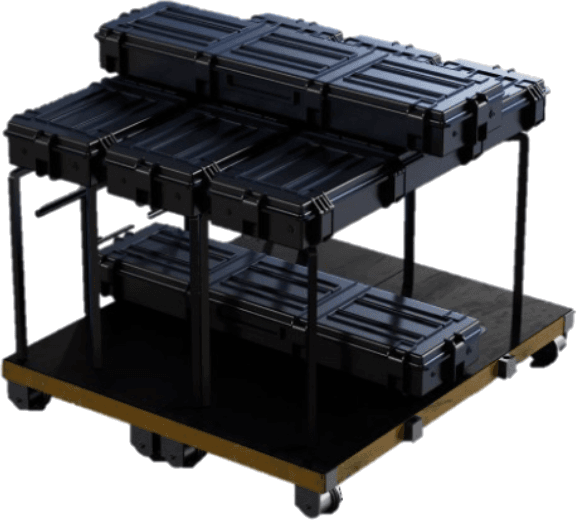
Configurable detectors for imaging large structures and surrounding ground when access or time is constrained.
Muon imaging systems
A configurable, large-area detector system for non-invasive imaging of structures and surrounding ground.
| Size | 1.4 m × 1.2 m active area |
|---|---|
| Protection | IP67 |
| Deployment | Portable |
Our large-area muon imaging system provides a practical solution for non-invasive, wide-coverage subsurface imaging, particularly suited for applications in which access time is very tight, such as (but not limited to) railway tunnel assessment, underground construction monitoring, and geotechnical surveys. Designed to operate in challenging environments, the system enables engineers to detect voids, structural inhomogeneities, and density anomalies in and around existing infrastructure—without the need for drilling or disruption to ongoing operations.
The system combines multiple detector modules to form a configurable array, offering an active imaging area of 1 m² or more, depending on project needs. It passively records cosmic muons that naturally penetrate the Earth, allowing for the measurement of relative density through overlying structures such as tunnel linings, retaining walls, and surrounding geology.
The result is a detailed map of internal conditions—ideal for identifying hidden voids behind tunnel linings, areas of material loss, or zones of water ingress that may pose long-term maintenance or safety concerns.
The system is designed with field performance in mind. It features robust construction, straightforward setup, and integration with mobile and desktop data acquisition tools. Combined with our image reconstruction software, the system supports timely analysis and clear visual outputs that aid engineering decision-making.
Housed within an IP66-rated case, the imager can operate in harsh environments.
The Large Planar System can be placed in or around the region of interest to image it clearly.
The system can be scaled by adding more detectors to the network, increasing measurement speed and shortening acquisition time.