
Introduction
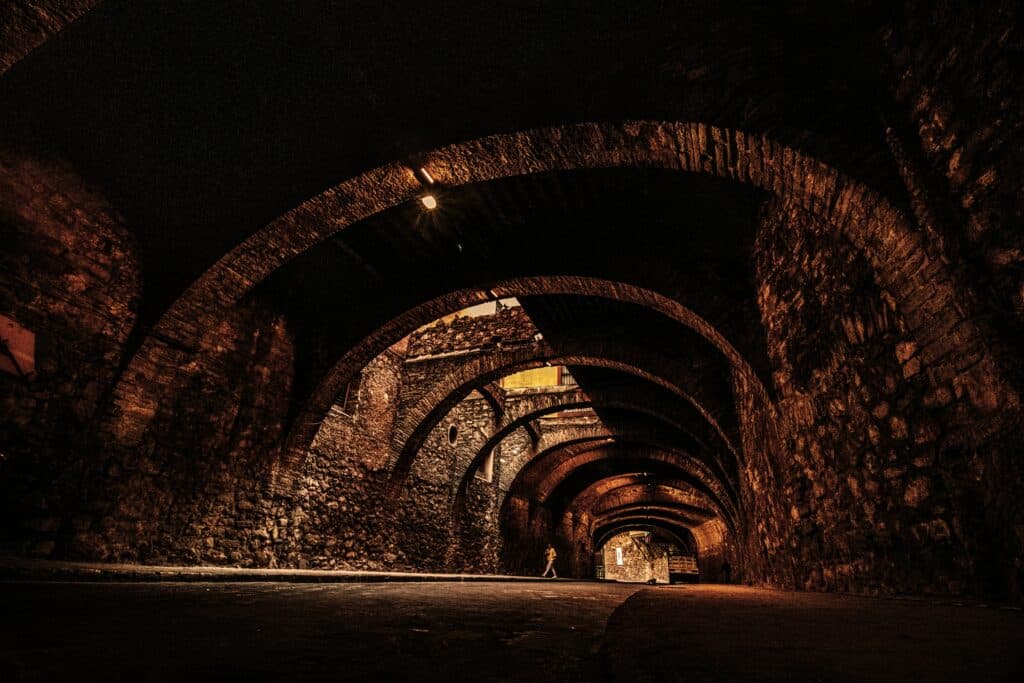
Reliable positioning in tunnels and underground environments remains a significant challenge, as satellite-based navigation systems are unavailable and conventional alternatives can be limited by infrastructure, access, or environmental conditions. Addressing this gap requires new approaches that can operate passively, robustly, and independently of external signals.
Geoptic is working with partners in the defence sector on the development of a muon-based positioning system designed specifically for tunnel and subsurface environments. The project explores how naturally occurring cosmic-ray muons—high-energy particles that continuously penetrate the Earth’s surface—can be used as a signal source to support positioning where traditional technologies are ineffective.
By leveraging the predictable interaction of muons with surrounding ground and structural materials, the work investigates system concepts, detector configurations, and data interpretation approaches suitable for complex underground settings. This research-led development aims to demonstrate the potential of muon-based positioning as a complementary technology for navigation and situational awareness in GPS-denied tunnel environments, while maintaining a non-intrusive and passive operational footprint.
What is Muon Positioning?
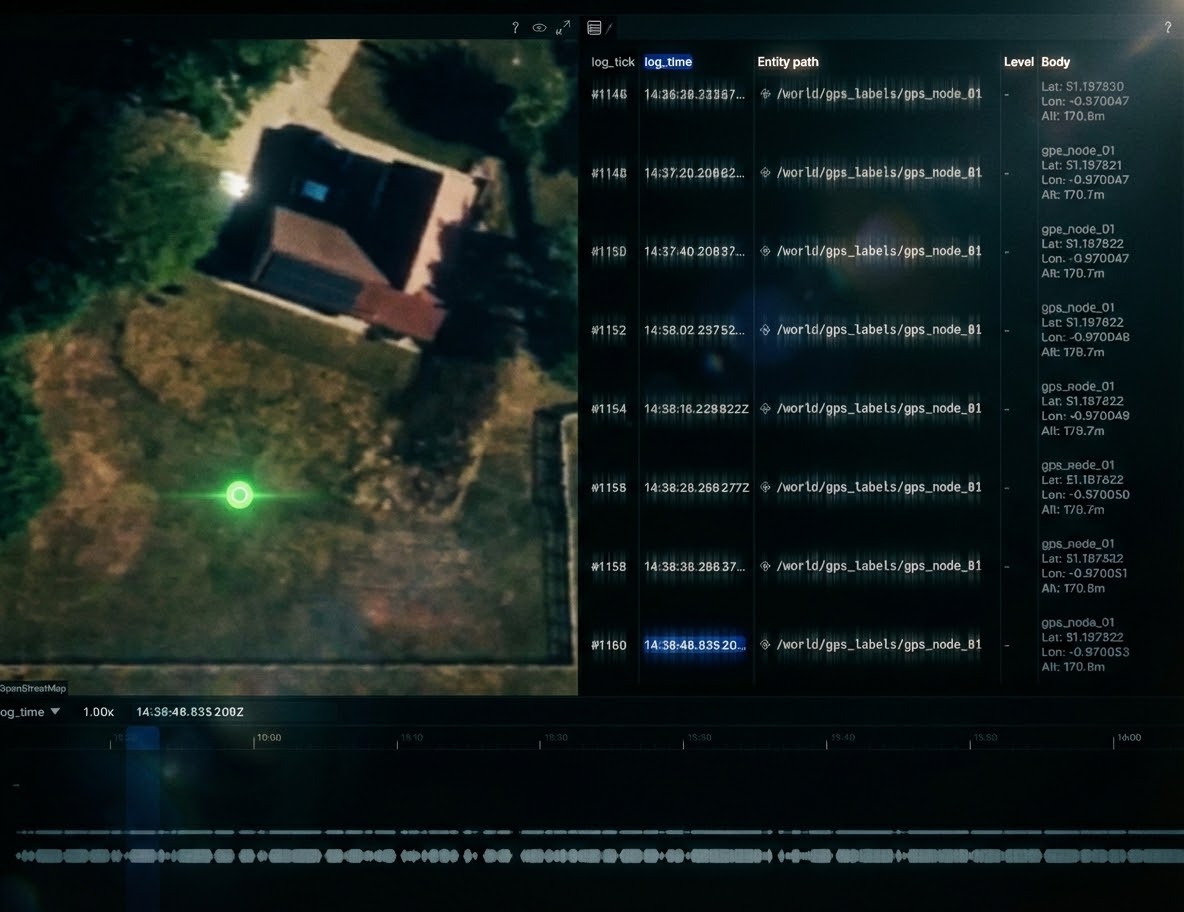
Reliable positioning in tunnels and underground environments remains a major challenge, as satellite-based navigation systems are unavailable and conventional alternatives are often constrained by infrastructure requirements, limited access, or adverse environmental conditions. Addressing this capability gap calls for new positioning approaches that can operate passively, robustly, and independently of external signals.
Geoptic is working with partners in the defence sector to develop a muon-based positioning system tailored for tunnel and subsurface environments. The project investigates the use of naturally occurring cosmic-ray muons, high-energy particles that continuously penetrate the Earth’s surface, as a signal source for positioning in locations where traditional technologies are ineffective.
The work explores system architectures, detector configurations, and data interpretation techniques suitable for complex underground settings. This research-led collaborative development seeks to demonstrate the potential of muon-based positioning as a complementary technology for navigation and situational awareness in GPS-denied tunnel environments, while maintaining a passive and non-intrusive operational footprint.
Why use Muons for Underground Positioning?
Positioning in tunnels and underground environments is challenging because many conventional navigation technologies rely on signals that cannot penetrate rock, soil, or dense structures. Muon positioning offers a complementary alternative that addresses several of these limitations.
– Muon Positioning works where GPS and radio-based systems cannot
Positioning in tunnels and underground environments is challenging because many conventional navigation technologies rely on signals that cannot penetrate rock, soil, or dense structures. Muon positioning offers a complementary alternative that addresses several of these limitations.
Satellite navigation signals do not reach underground spaces, and radio-based alternatives such as Wi-Fi, Bluetooth, or ultra-wideband require pre-installed infrastructure that may not exist, may be damaged, or may be impractical to deploy. Muon positioning relies on naturally occurring cosmic-ray muons, which penetrate deep underground without the need for transmitters or repeaters.
– Muon Positioning is passive and non-intrusive
Muon positioning does not require the emission of signals, active beacons, or ground disturbance. This makes it well suited to environments where non-intrusive operation is important, such as operational tunnels, historic infrastructure, or sensitive sites.
– Muon Positioning is resilient to environmental conditions
Many underground positioning methods are affected by dust, smoke, water, electromagnetic interference, or structural complexity. Muons are largely unaffected by these factors, allowing positioning information to be derived even in visually degraded or electromagnetically noisy environments.
– Muon Positioning reduces reliance on fixed infrastructure
Some underground navigation systems depend on surveyed reference points, installed markers, or continuous calibration. Muon positioning can operate with minimal fixed infrastructure, particularly when used in configurations that reference known surface locations. This can reduce preparation time and improve flexibility in complex or changing environments.
– Muon Positioning complements existing navigation methods
Muon positioning is not intended to replace conventional systems entirely. Instead, it can provide an independent source of positioning information that complements inertial navigation, odometry, or map-based approaches. Used together, these methods can improve confidence and robustness in GPS-denied environments and improve the robustness of existing approaches.
– Muon Positioning is well suited to complex subsurface geometry
Tunnels, caverns, and underground networks often have irregular geometry and variable construction materials. Muon positioning leverages the interaction between muons and surrounding structures, allowing location estimates that remain meaningful even in complex underground settings.
– Muon Positioning enhances the conventional muon subsurface mapping capability
This capability will be combined with established muon mapping techniques to provide contextual awareness of the surrounding subsurface environment alongside positioning information. By integrating positioning outputs with conventional muon-based mapping, the system can support both localisation and environmental characterisation, enabling users to understand not only where they are, but also the structure and features of the tunnel or underground space around them. This combined approach enhances operational utility while leveraging a common sensing modality and passive detection infrastructure.
Muon Positioning and Imaging
A Key Combination for Enhanced Subsurface Intelligence
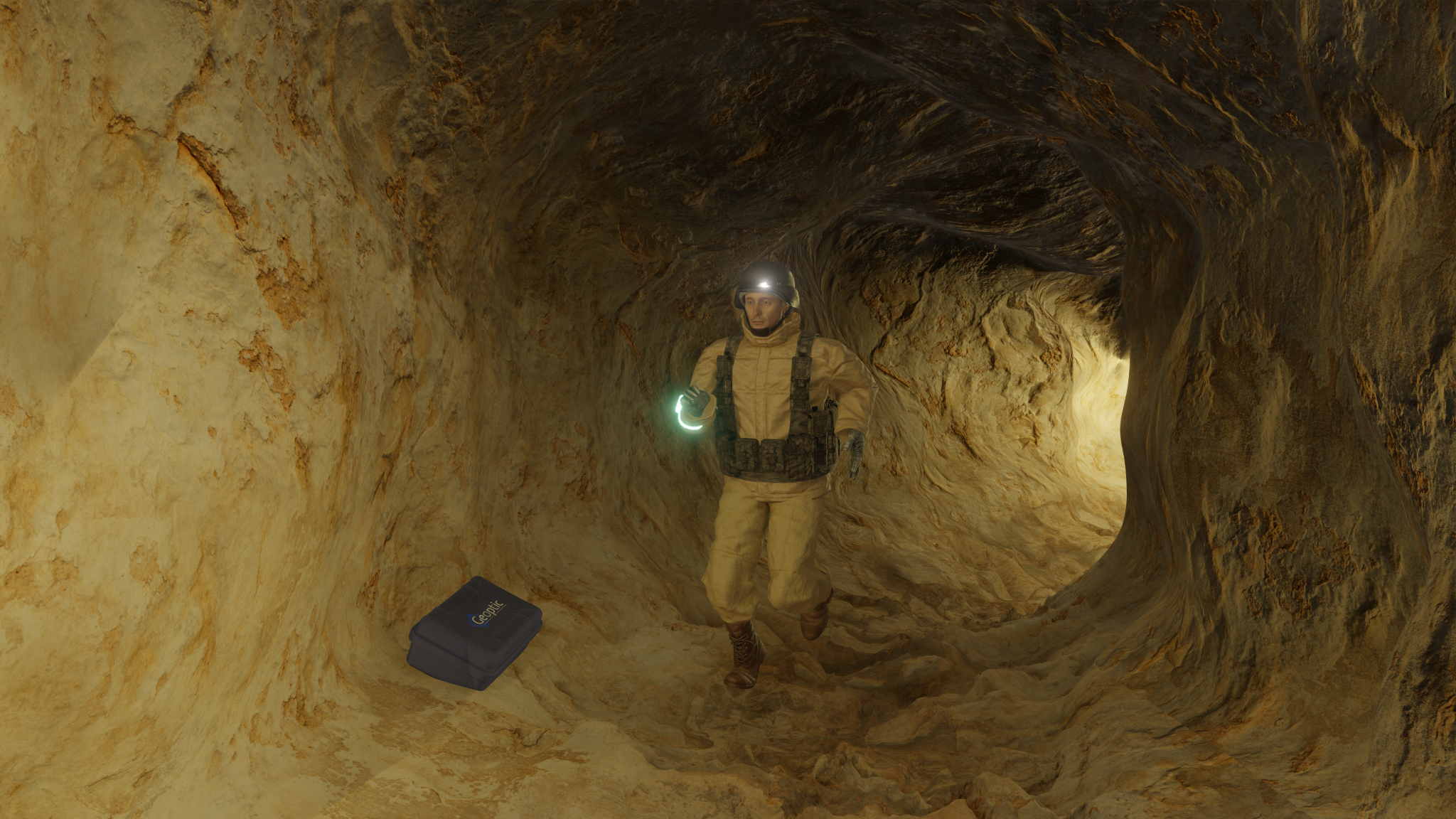
The integration of muon-based positioning with established muon imaging capabilities offers a unique and resilient solution to the challenges of operating in contested, cluttered, and GPS-denied subsurface environments. For defence applications, this combined capability enables both precise localisation and continuous situational awareness in tunnels, underground facilities, and hardened structures where conventional sensing and navigation technologies are ineffective or compromised.
Geoptic is working with partners in the defence sector on the development of a muon-based positioning system designed specifically for tunnel and subsurface environments. The project explores how naturally occurring cosmic-ray muons—high-energy particles that continuously penetrate the Earth’s surface—can be used as a signal source to support positioning where traditional technologies are ineffective.
By leveraging the predictable interaction of muons with surrounding ground and structural materials, the work investigates system concepts, detector configurations, and data interpretation approaches suitable for complex underground settings. This research-led development aims to demonstrate the potential of muon-based positioning as a complementary technology for navigation and situational awareness in GPS-denied tunnel environments, while maintaining a non-intrusive and passive operational footprint.
Muon Waypoint Positioning Using Surface and Subsurface Reference Detectors
Overview
The muon positioning method uses coordinated deployments of high-resolution, compact muon detectors at the surface and within tunnels or other subsurface environments. Surface-based detectors act as fixed reference nodes and continuously measure the flux and angular distribution of naturally occurring cosmic-ray muons. These measurements establish a stable, passive reference frame for positioning.
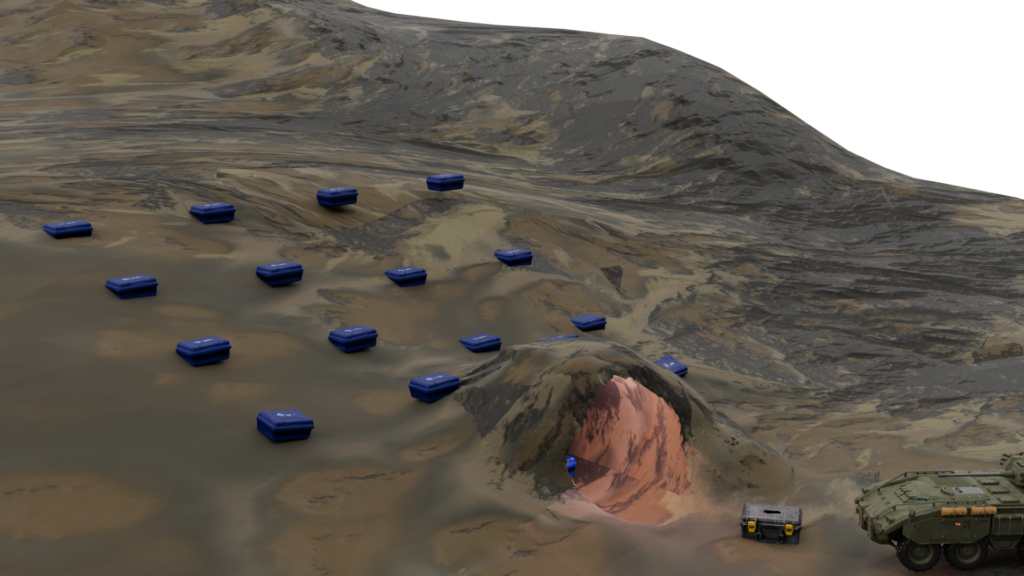
Subsurface detectors positioned within tunnels record the same muon population after it passes through the overburden and surrounding materials. The system correlates muon trajectories, timing, and angular information between surface reference detectors and subsurface units to determine the relative position of the underground detector. This approach exploits the predictable propagation of high-energy muons through soil, rock, and engineered structures, without requiring active transmissions or pre-installed infrastructure inside the tunnel network.
High-resolution, compact detectors at both surface and subsurface locations enable practical positioning performance. Improved spatial and angular resolution supports accurate matching of muon tracks across detector layers, while compact form factors allow deployment in confined environments such as narrow tunnels, shafts, and access points. Using a common detector architecture across reference and subsurface nodes simplifies calibration, logistics, and data processing, and supports scalable system configurations.
This surface-to-subsurface muon positioning approach delivers a passive, low-signature capability for defence operations in GPS-denied environments. When combined with muon imaging and mapping, the same detector network supports both localisation and environmental characterisation, providing enhanced situational awareness and subsurface intelligence without reliance on external signals or emissions.
Our System Implementation
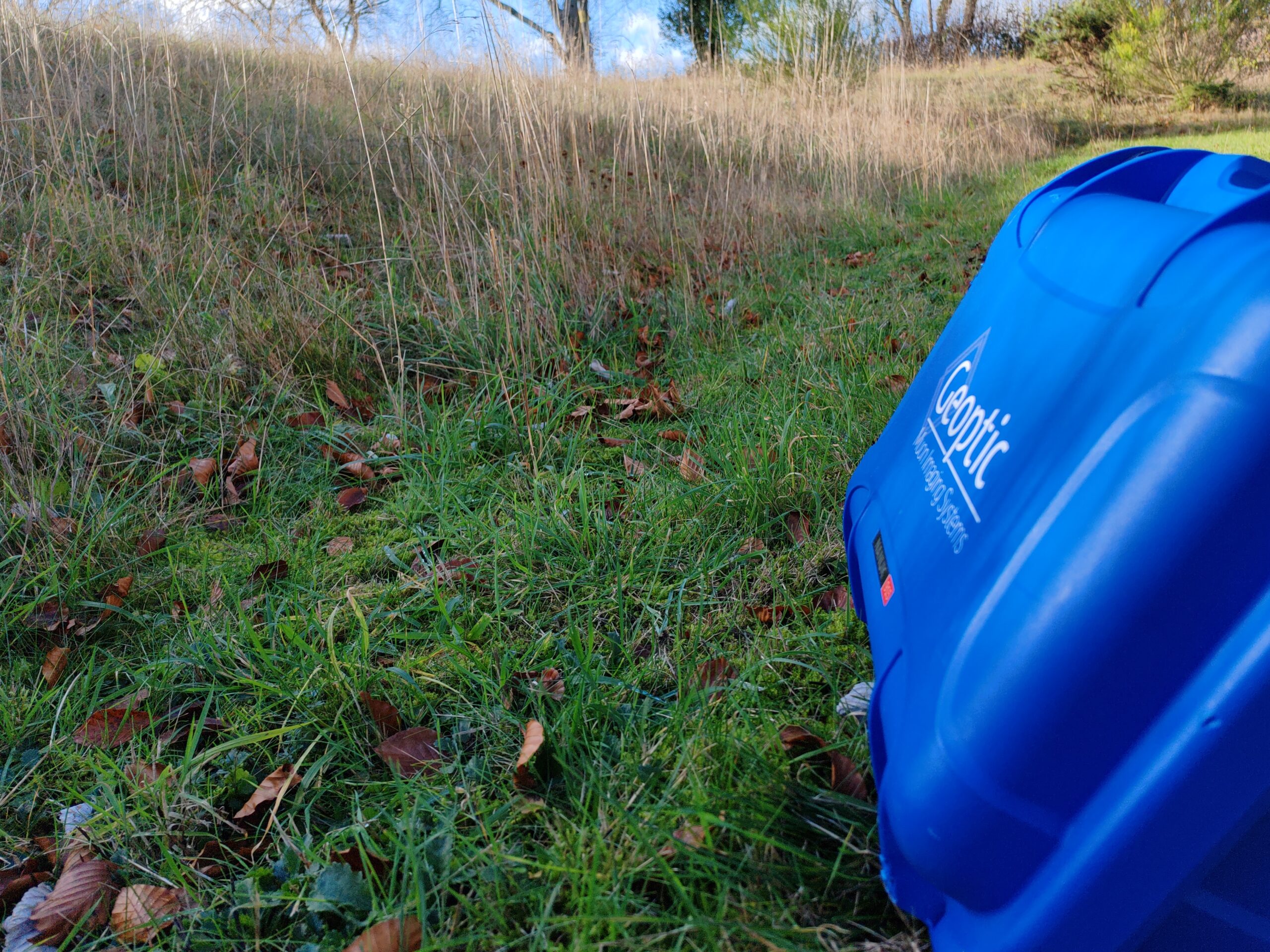
Geoptic’s compact, high-resolution detector is modular and rugged. Combined with scalable manufacturing and deployment of multiple units, this architecture enables integrated systems to cover large areas. By using an approach with many smaller units, the system is much more configurable, easy to deploy, and allows for deeper operation as it suppresses false coincidences.
Summary
Key findings
- Demonstrations confirm that muon positioning can reliably transfer known surface reference positions into tunnel, subsurface, and underwater environments where satellite navigation is unavailable.
- Measurements collected across multiple detector geometries produce consistent and repeatable localisation results, supporting confident positioning relative to surveyed surface control points.
- The passive technique operates without active emissions, pre-installed infrastructure, or line-of-sight access to the surface, maintaining effectiveness across extended ranges and complex overburden.
- Positioning performance remains stable over time, avoiding the cumulative errors associated with inertial or dead-reckoning approaches and enabling persistent localisation in GPS-denied environments.
Overall conclusion
Muon positioning delivers a unique capability to transfer accurately surveyed surface positions into tunnels, underground, and underwater environments where GPS and conventional navigation systems cannot operate. By correlating naturally occurring cosmic-ray muons measured from fixed surface reference detectors and subsurface or subsea receivers, the system provides bounded, absolute localisation relative to known surface control points without active transmissions, beacons, or installed infrastructure. This passive, low-signature approach overcomes the limitations of inertial drift and dead reckoning, enabling persistent positioning, navigation, and situational awareness in complex subsurface and GPS-inhibited environments.