
Introduction
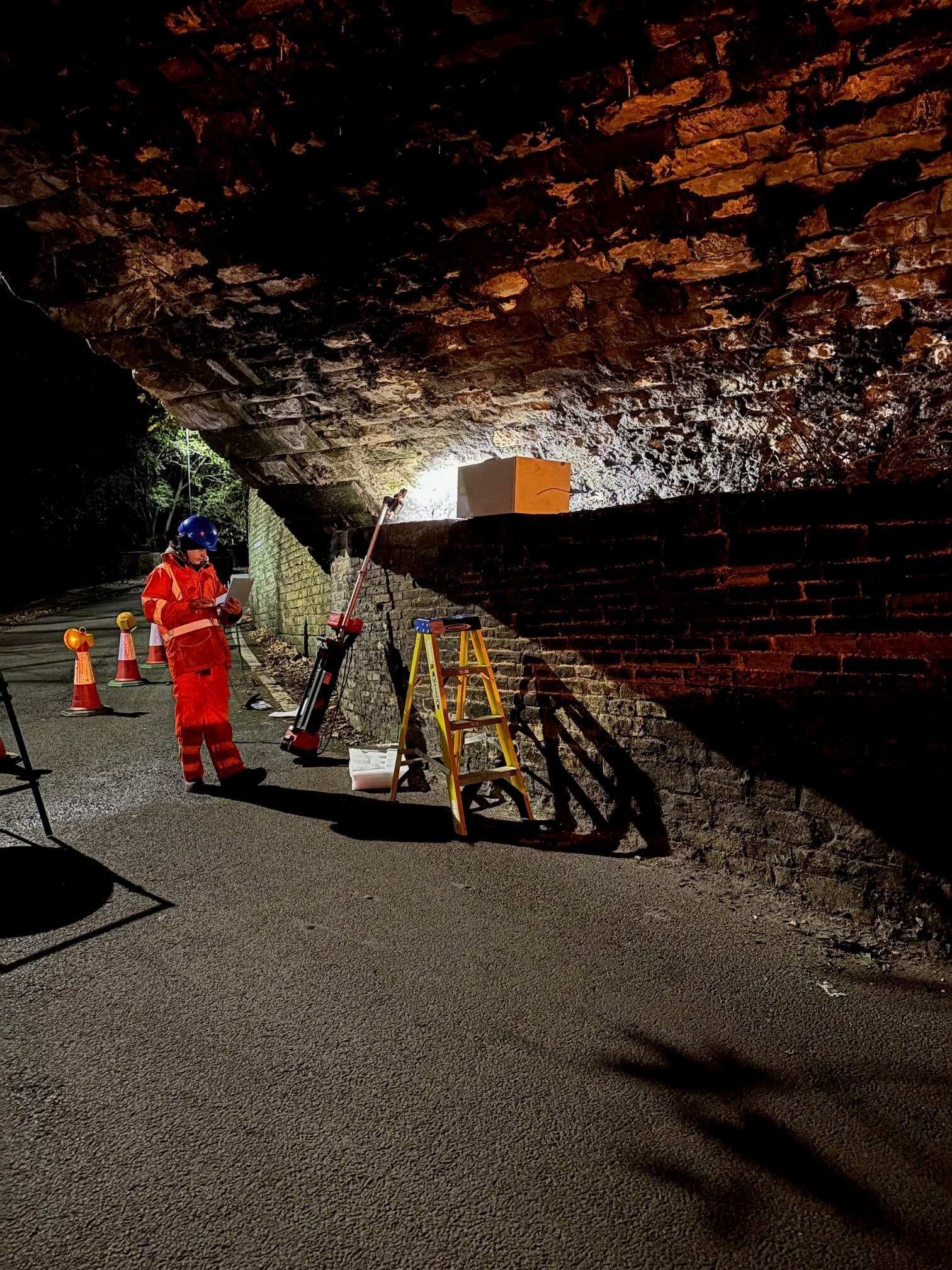
Geoptic was commissioned to undertake a muon imaging (muography) survey at the Railway Viaduct to support the non-intrusive assessment of its internal condition. The project focused on assessing internal density variation within the viaduct abutments and spandrel regions – areas that are difficult to verify using conventional intrusive techniques. By deploying compact muon detectors beneath and adjacent to the structure, the survey provided density-based insight into the viaduct’s internal fabric without drilling, excavation, or disruption to the asset or its surroundings.
What is Muon Imaging?

Muon imaging, often referred to as muography, is a passive geophysical technique that uses naturally occurring cosmic ray muons to estimate variations in density within large structures and the ground around them. Muons are high-energy particles produced when cosmic rays interact with the upper atmosphere. At ground level they arrive continuously from above and, because they are highly penetrating, many will pass through substantial thicknesses of masonry, soil, and rock.
A muon imaging detector measures the direction and rate of muons that reach it after travelling through the target volume. Where the muons have had to pass through denser material, fewer will arrive, and their trajectories may be altered more. Where muons pass through lower-density regions, such as voids or less compacted ground, a higher flux is typically recorded. By collecting data over time and comparing the measured muon flux from different angles, it is possible to reconstruct a map or model of relative density.
Why use Muon Imaging for Viaduct Surveys?
Muon imaging provides a genuinely non-intrusive way to investigate the internal viaduct structure
Historic viaducts often contain intentional or accidental voids within abutments and spandrels, many of which are inaccessible to conventional inspection. Intrusive methods such as drilling and coring can be disruptive, costly, and limited in reach—particularly where structures are buried, live, or constrained. Muon imaging uses naturally occurring cosmic-ray particles to probe deep within the structure, allowing internal density variations to be assessed without physical intervention.
The technique is well suited to large, thick, and complex masonry structures.
Unlike near-surface geophysical methods, muons naturally penetrate many metres of masonry, concrete, and ground, making the technique effective for viaducts with substantial section thicknesses. By measuring how muons are attenuated along different paths through the structure, muon imaging provides quantitative, line-of-sight density information. This allows engineers to distinguish between regions with contrasting internal density characteristics.
Muon imaging supports proportionate investigation planning and informed asset management.
The outputs from a muon survey are density-based interpretations that help reduce uncertainty around the internal condition of a viaduct. When used alongside historical records, visual inspections, and targeted intrusive investigations, muography can support proportionate investigation planning and informed asset management, and avoid ultimately unnecessary intervention. As a passive, low-impact technique, it is particularly valuable where maintaining asset integrity and minimising disruption are critical considerations.
Muon Imaging: Reducing Investigation Risk and Cost Through Better Targeting
Muon imaging is most effective when used to complement targeted coring and drilling, rather than replace them. While intrusive investigations provide direct material confirmation at specific locations, they are limited in spatial coverage and can be costly, disruptive, and constrained by access. Muon imaging provides a broader, non-intrusive view of internal density variations across large volumes of a viaduct, helping to identify areas of contrasting internal density and areas where density characteristics are more uniform. This allows intrusive works to be better targeted, reducing the number of cores required, minimising unnecessary intervention, and ultimately lowering investigation costs and programme risk while increasing confidence in the findings.
Non-Contact and Non-invasive
Muon imaging occupies a different position in the structural diagnostic toolkit. It is passive and non-intrusive, and it can be deployed where surface access is limited, as it does not require transmitters, coupling to the ground, or drilling. Instead, it builds up a picture of density by recording cosmic ray muons over time. The principal limitation is that it typically requires an exposure period to accumulate sufficient data. Muography is often used to highlight density anomalies that can guide targeted inspection and verification, rather than as a standalone replacement for established inspection and investigation methods.
Large Volume “X-ray” to See Inside
Where information is needed beyond the lining, intrusive methods such as boreholes, trial pits, core sampling, and probe drilling can provide a high-confidence ground truth, including material identification and laboratory testing. The trade-off is that these methods introduce disturbance, can be expensive to permit and mobilise in urban settings, and may only sample discrete points, leaving uncertainty between locations.
Insensitive to Ground Environmental Conditions
Ground-based geophysical techniques, including ground penetrating radar, electrical resistivity, and seismic methods, can help interpolate between points, but their performance is sensitive to ground conditions, access geometry, and site noise, and they can be challenging to deploy where the surface is constrained.
The Viaduct Muography Survey Setup
Muon Survey Overview
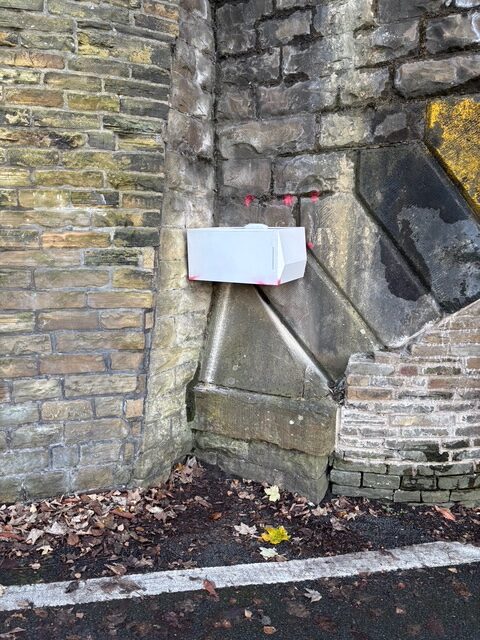
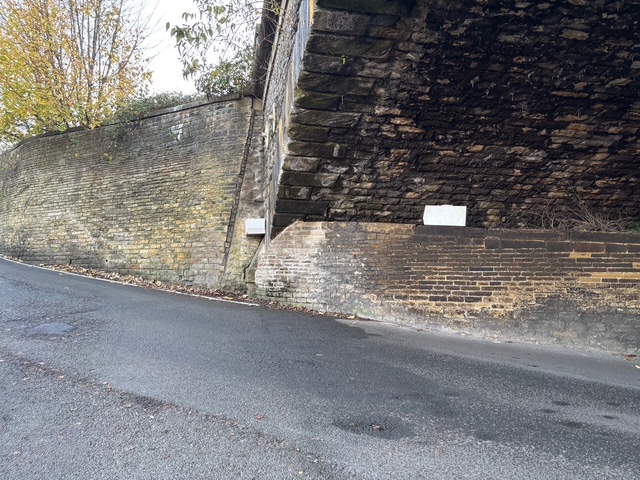
Geoptic’s compact, high resolution muon imaging detectors were mounted directly onto the viaduct structure at carefully selected locations to provide effective coverage of the abutment and spandrel regions of interest. Compact detectors were installed beneath the barrel arch and adjacent to the pier walls, positioned as close to the masonry as practicable. Each detector was housed within a secure, anti-tamper cabinet and mechanically fixed to the structure, providing stable alignment and protection while allowing long-duration, unattended data collection.
The detectors were oriented at defined angles to optimise their field of view through the suspected voided zones, with deployments planned using prior structural information and supported by 3D modelling. Multiple detector positions were used to view the same volume from different directions, improving confidence in the interpretation and reducing ambiguity. This flexible, low-impact installation approach enabled data acquisition under live infrastructure conditions without drilling, excavation, or interference with normal operation of the viaduct or surrounding environment.
Deployment Without Traffic or Rail Closures
Muon imaging detectors were deployed at the Viaduct in compact, secure configurations designed for long-duration, unattended operation beneath live infrastructure. Detectors were installed beneath the barrel arch and adjacent to the pier wall at each abutment, providing complementary viewing angles through the spandrel regions. Each unit was housed within an anti-tamper cabinet and fixed to the masonry to ensure stable alignment, with orientations selected to maximise sensitivity to potential voided zones.
Open-sky calibration measurements were carried out to establish baseline muon flux and correct for atmospheric and instrumental effects. Data were collected continuously over extended exposure periods to achieve robust statistics, with muon transmission and opacity values derived across multiple lines of sight. These measurements were subsequently compared with outputs from a detailed 3D model of the viaduct and its surroundings, enabling quantitative interpretation of internal density variations.
Survey Operations
Routine operational checks were carried out throughout the deployment to confirm detector alignment stability and system performance, with environmental exposure managed using weather-rated enclosures and protected cable routing to mitigate moisture ingress and temperature variation. Data acquisition took place over extended measurement periods, with detectors left in place for several hours to multiple days depending on location and access constraints. Meteorological conditions were monitored to account for atmospheric pressure effects on muon flux, and open-sky calibration data were used to normalise survey measurements. The surrounding urban environment and terrain were incorporated into the analysis through detailed 3D modelling, enabling the influence of overlying ground and nearby structures to be distinguished from internal features of the viaduct, and allowing high-quality data to be collected under live infrastructure conditions with minimal disruption.
Summary
Key findings
- Measurements demonstrated that muon imaging can distinguish between regions with contrasting internal density characteristics within a large masonry viaduct.
- Data collected from multiple viewing angles provided consistent results, supporting confident interpretation of internal density variation while avoiding intrusive investigation.
Interpretation
- The observed density reduction at the investigated abutment is consistent with contrasting internal density characteristics observed within the surveyed volume.
- Results were cross-checked against independent modelling and interpreted alongside existing investigation records, noting that the non-intrusive survey sampled a deeper and different internal volume than previous coreholes.
Overall conclusion
This case study demonstrates the capability of muon imaging to non-intrusively identify and characterise internal density contrasts within complex masonry viaducts. By providing insight into concealed internal characteristics that are difficult to assess using conventional techniques, muography offers a valuable complementary tool for investigation planning where access is limited and minimising disruption is a priority.