Railway tunnels can inherit risks from the ground above and around them. In former mining areas, historic workings may predate the railway by many years. Shafts, galleries and voids can be difficult to locate from the surface, especially where records are incomplete.
Muon imaging offers a way to investigate these areas without drilling during the initial survey. Detectors measure naturally occurring cosmic-ray muons after they have travelled through the ground above the tunnel. Changes in the measured muon flux can indicate differences in density within the overburden.
Surveying a tunnel with a deeper history
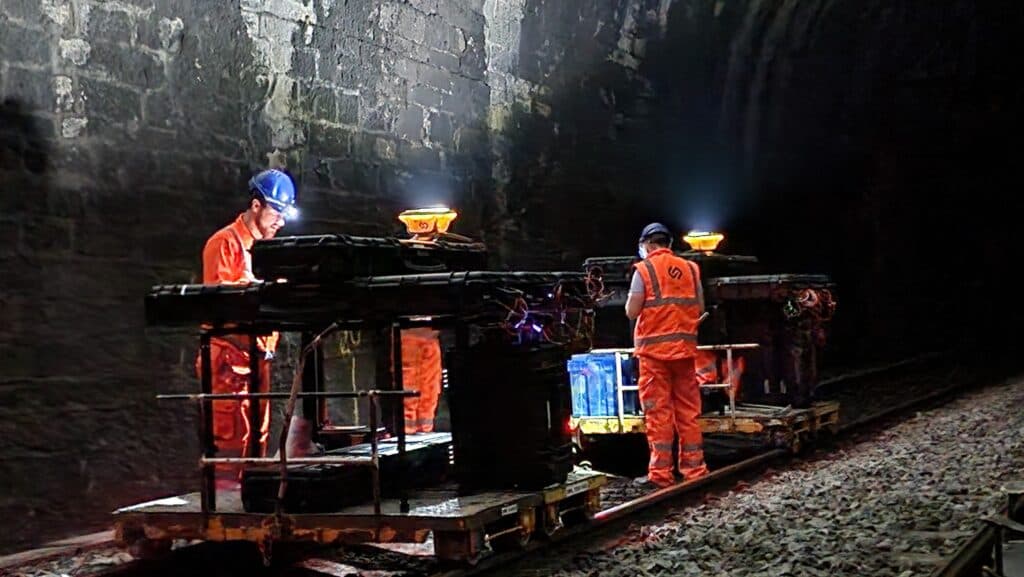
In May 2026, Geoptic carried out a three-day muon survey in a historic railway tunnel passing through former coal-mining ground.
The survey used two detector systems at 12 measurement stations. The stations were spaced 2.5 metres apart. The overlapping deployment allowed neighbouring measurements to be compared while making use of the planned tunnel closure.
Looking for more than railway construction features
The survey was designed to investigate possible features above and around the tunnel. The question was not limited to where the railway builders had worked. Older mining activity could also have left galleries, shafts or other changes in the ground.
The analysis identified a likely concealed shaft rising towards the surface. It also produced indications of a mining gallery running parallel to the tunnel.
These descriptions are deliberate. A likely feature and an indication are not the same as a confirmed structure. The results provide defined areas for follow-up investigation while retaining the distinction between what the measurements support and what still needs physical verification.
Making follow-up work more focused
Muon imaging does not replace coring, inspection or engineering judgement. It can help engineers to quickly decide and save costs where other investigative or remediation methods should be used next.
Instead of treating the full tunnel and its surrounding ground as one large unknown, the survey can help focus further work on specific features. That may reduce exploratory investigation in the wrong places and make better use of future access windows.
For historic tunnels in former mining ground, the first step is often to understand where the uncertainty is concentrated. Passive muon imaging can provide that wider view before intrusive investigation begins.
If you need to investigate density changes above or around a tunnel without drilling during the initial survey, contact Geoptic.