
Introduction
Monitoring stored carbon dioxide is essential for ensuring the safety, performance, and regulatory compliance of carbon capture and storage projects. As CO₂ migrates and consolidates underground, operators require monitoring technologies that are reliable, continuous, and cost effective, while minimising disruption to site operations.
Cosmic ray muon imaging provides a novel approach to subsurface monitoring. By measuring naturally occurring subatomic particles that continuously pass through the Earth, muon imaging can identify density changes caused by injected CO₂ displacing formation fluids. This enables non-invasive, in situ observation of CO₂ plume location, extent, and movement over time.
This work presents the world’s first pilot study demonstrating the feasibility of using muon imaging to monitor stored CO₂ at a shallow test site in Norway. The results show that muon imaging can successfully detect and characterise a CO₂ plume, with findings validated against independent seismic measurements. These outcomes highlight the potential of muon imaging as a complementary monitoring solution for future carbon storage developments.
What is Muon Imaging?

Muon imaging, often referred to as muography, is a passive geophysical technique that uses naturally occurring cosmic ray muons to estimate variations in density within large structures and the ground around them. Muons are high-energy particles produced when cosmic rays interact with the upper atmosphere. At ground level they arrive continuously from above and, because they are highly penetrating, many will pass through substantial thicknesses of masonry, soil, and rock.
A muon imaging detector measures the direction and rate of muons that reach it after travelling through the target volume. Where the muons have had to pass through denser material, fewer will arrive, and their trajectories may be altered more. Where muons pass through lower-density regions, such as voids or less compacted ground, a higher flux is typically recorded. By collecting data over time and comparing the measured muon flux from different angles, it is possible to reconstruct a map or model of relative density.
Why use Muon Imaging for CO2 Monitoring?
Muon imaging is particularly well suited to monitoring stored carbon dioxide because it provides continuous, independent measurements of subsurface density change using a passive and non-invasive technique. This makes it an effective complement to existing monitoring approaches, while also addressing cost, risk, and operational constraints associated with conventional methods.
Reduced monitoring costs
Seismic surveys remain a powerful tool for CO₂ storage monitoring, but they are typically episodic, logistically complex, and expensive to repeat at high frequency. Muon imaging systems are installed once and operate continuously with low power requirements, significantly reducing the need for frequent repeat seismic campaigns.
By providing ongoing plume monitoring between seismic surveys, muon imaging can reduce the overall number of seismic acquisitions required across the lifetime of a storage site. This leads to lower operational costs while maintaining high confidence in plume tracking and containment assurance.
Early detection and risk reduction through continuous monitoring
Unlike time-lapse seismic surveys, which provide snapshots of plume evolution at discrete intervals, muon imaging delivers continuous in situ monitoring of subsurface density changes. This enables earlier identification of unexpected plume migration or changes in plume geometry.
Early detection allows operators to enact mitigation measures or increase monitoring activity at an early stage, reducing environmental and regulatory risk. Continuous monitoring is particularly valuable during injection and early post-injection phases, when plume evolution can be most dynamic.
Complementary and independent of seismic measurements
Muon imaging provides a direct and independent measurement of bulk density change, derived from the attenuation of naturally occurring cosmic ray muons. This makes it fundamentally different from seismic methods, which infer density indirectly and can admit multiple plausible solutions depending on assumptions about rock properties and fluid substitution.
In CO₂ injection test measurements, seismic inversion produced a range of possible density outcomes, while muon data was able to constrain this uncertainty by providing an independent density estimate. When used together, seismic and muon measurements improve overall confidence in plume characterisation.
Muon imaging is also resilient to environmental and industrial noise, and can be deployed near sources of acoustic interference where seismic data quality may be compromised. This allows monitoring in settings that are challenging for traditional geophysical techniques.
The Borehole Muography Setup
Overview
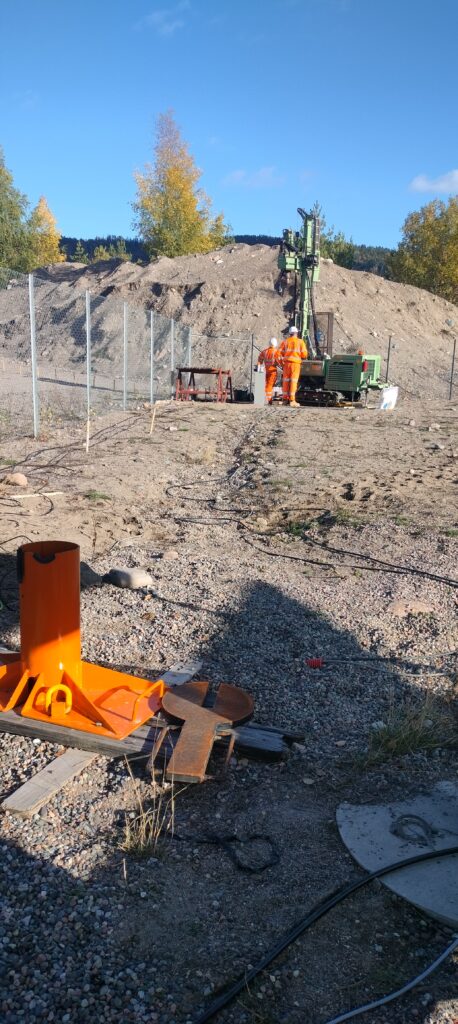
The borehole muon monitoring system consists of a linear array of compact muon detector units deployed within standard vertical boreholes. Each detector array is designed to provide continuous subsurface coverage across the expected depth range of the CO₂ plume.
In the pilot study, each borehole array comprised 13 individual detector units installed in a vertical arrangement spanning depths from approximately 37 m to 67 m below ground level. This configuration allowed the detectors to sample a wide range of muon trajectories passing through the storage formation and surrounding geology.
Each detector unit is housed in a marine-grade stainless steel enclosure suitable for long-term subsurface deployment. Each unit is 2.2 m long and has a total mass of around 15 kg, with a conical field of view of roughly 50 degrees. This geometry enables each detector to measure muon flux along many overlapping lines of sight through the subsurface.
The detectors use robust scintillator material coupled to an array of photosensors to detect passing muons and reconstruct their trajectories. Muon detection rates are recorded continuously and transmitted to the surface via Ethernet connections. All units are powered from the surface, with an average power consumption of approximately 5 W per detector.
Multiple borehole arrays can be deployed across a site. In the study configuration, one array was positioned near the CO₂ injection point to monitor plume development. Data from all detectors are managed through a surface control node, enabling remote operation, live system health monitoring, and secure data retrieval.
Injection and Monitoring
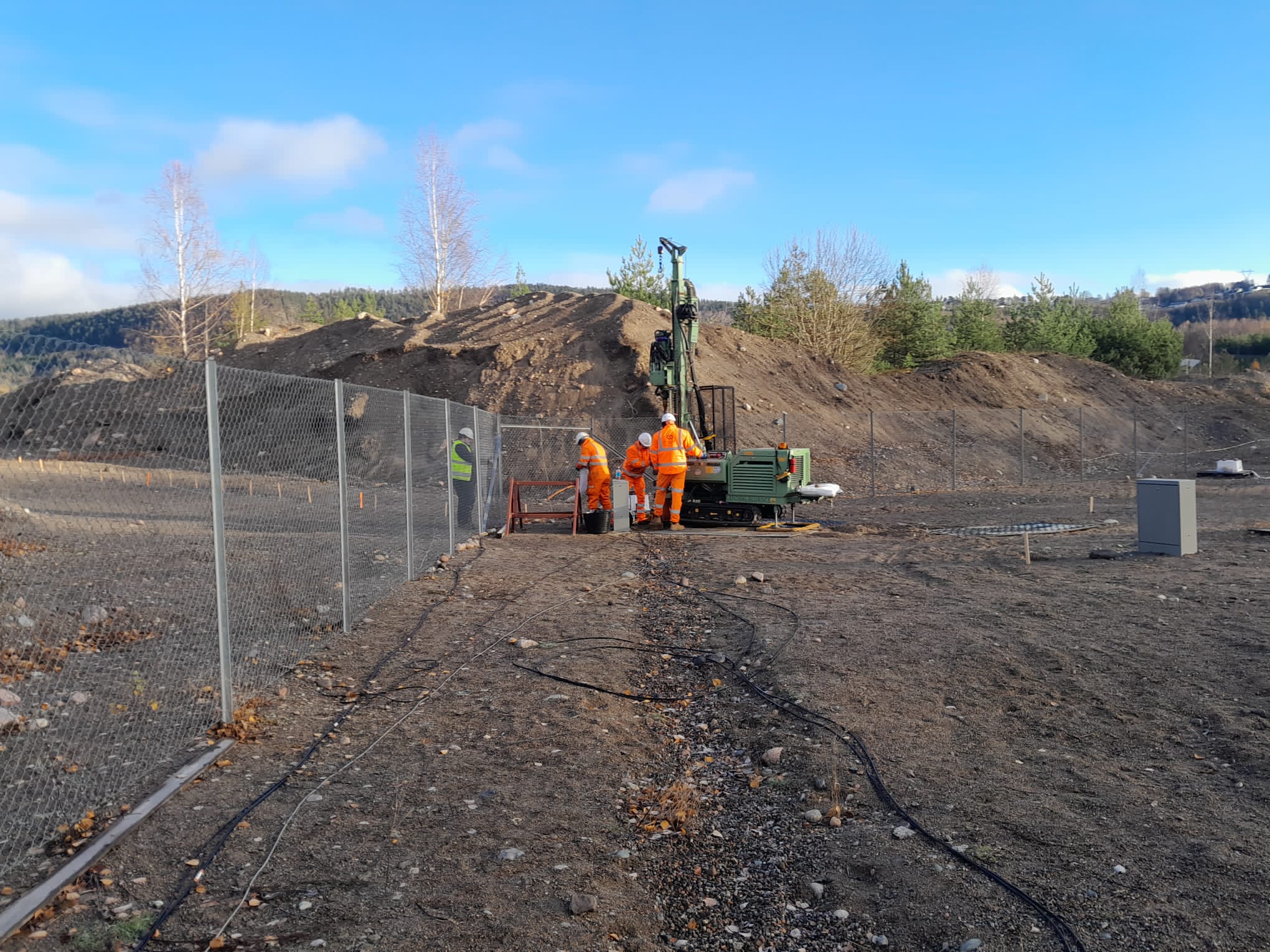
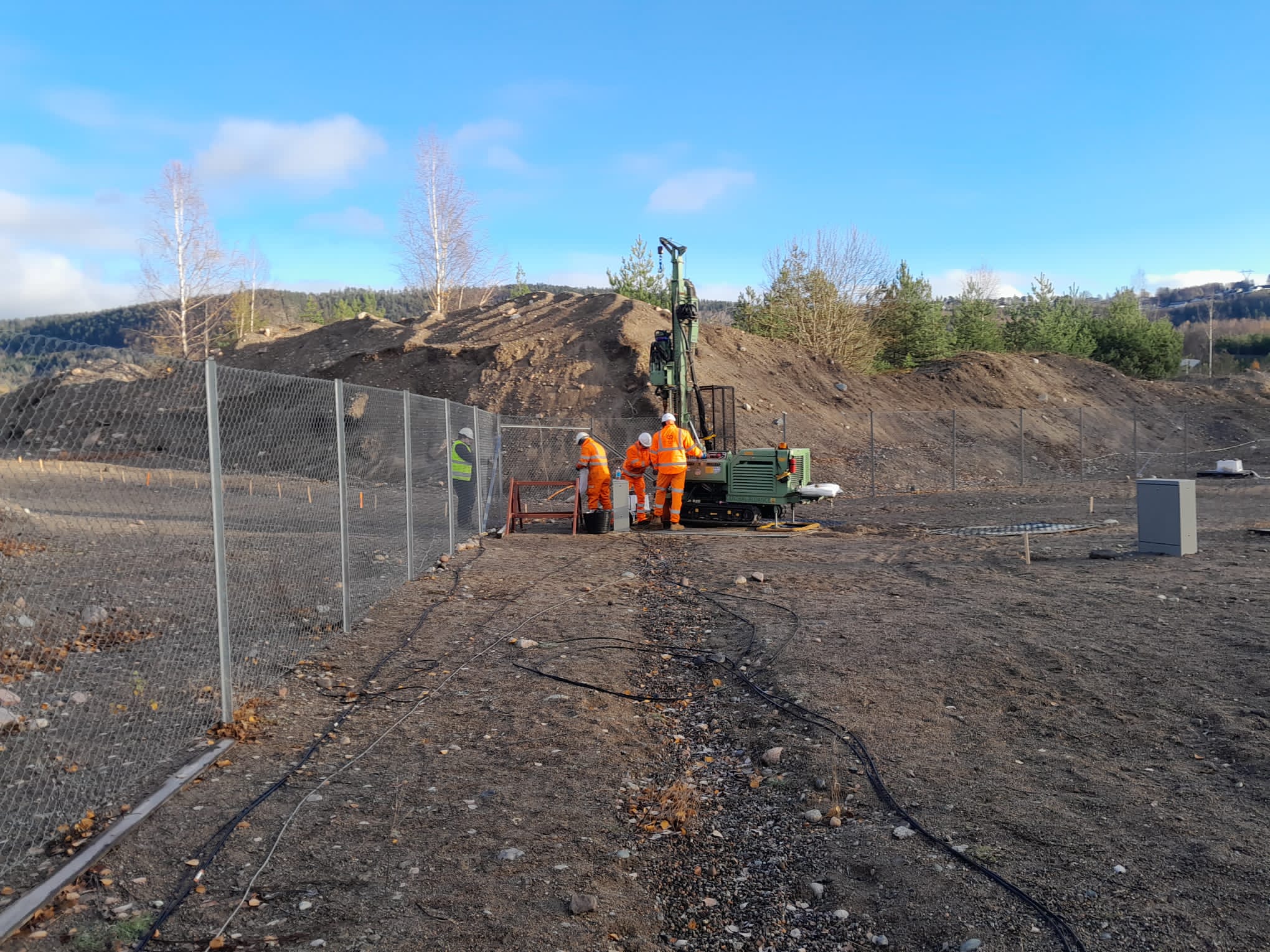
At the Norway shallow test site, two borehole muon detector arrays were installed to monitor how injected CO₂ altered subsurface density over time. Each array consisted of 13 detector units arranged vertically within a single borehole, covering depths of approximately 37 m to 67 m below ground level. One borehole was positioned close to the CO₂ injection point and the expected plume location to collect experimental data, while the second borehole was located sufficiently far from the injection area that injected CO₂ would have no influence. This second array provided a control dataset for comparison.
The detector array remained in place for 29 days and operated continuously throughout the test period. During this time, a total of 3.2 tonnes of CO₂ was injected into the subsurface. All detector units were connected to surface power and a data network, feeding into a surface control node that enabled remote data retrieval and live system performance monitoring via a secure internet connection.
Shortly after injection commenced, the experimental array recorded an increase in the measured muon rate, consistent with CO₂ displacing formation water and creating a lower-density region in the subsurface. Using the combined line-of-sight measurements from the detector array, a density inversion approach was applied to reconstruct three-dimensional density change. This reconstruction revealed a low-density feature consistent with the presence of a CO₂ plume. The geometry and radial extent of the plume inferred from the muon data were subsequently compared with seismic measurements, with both methods indicating a similar plume size and spatial extent.
Summary
This pilot study demonstrates that borehole muon imaging can successfully detect and characterise a shallow CO₂ plume under realistic field conditions. The results confirm that naturally occurring cosmic ray muons provide a sensitive and reliable means of measuring subsurface density change associated with CO₂ injection.
The agreement between muon-derived density reconstructions and independent seismic measurements provides strong validation of the technique, while also highlighting the value of muon imaging as a complementary monitoring method. By offering continuous, passive, and noise-resilient monitoring, muon imaging addresses key limitations of episodic geophysical surveys.
These findings establish muon imaging as a promising tool for long-term CO₂ storage monitoring, with the potential to reduce monitoring costs, improve early detection of plume migration, and enhance overall confidence in storage site performance and containment.